
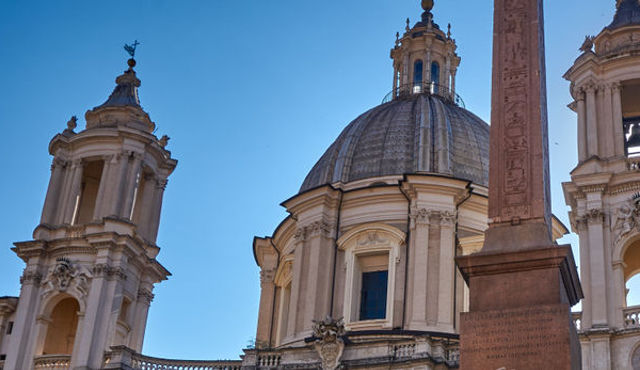
In short: Sant’Agnese in Agone is the Baroque church on the west side of Piazza Navona, begun in 1652 and shaped by Rainaldi, Borromini and Bernini. It is closed on Mondays and otherwise open in the mornings and afternoons. The crypt, with remains of the Stadium of Domitian, can only be visited by compulsory booking, for €5 (as of 14 November 2026) – and is not accessible for visitors with reduced mobility.
Key facts at a glance As of 14 November 2026
- Church opening hours
- Mon closed · Tue–Fri 9 am – 1 pm and 3–7 pm · Sat/Sun 9 am – 1 pm and 3–8 pm (as of 14 November 2026)
- Crypt
- Tue–Sat 9 am – 1 pm (last entry 12:30 pm) and 3–6 pm (last entry 5:30 pm) · booking compulsory · approx. 20 minutes
- Crypt admission
- €5 (adults); free for children aged 0–5, among others
- Church admission
- No ticket
- Mass times
- Sat 7 pm · Sundays and public holidays 12:15 pm and 7 pm
- Address
- Via di Santa Maria dell’Anima 30/A, west side of Piazza Navona, Rome
- Accessibility
- Not accessible for visitors with reduced mobility (church and crypt)
- Contact
- Tel. +39 06 68192134 · info@santagneseinagone.org
Sant’Agnese in Agone: booking the crypt & visiting the church
You can enter the church during normal opening hours. For the crypt, however, you need to book through Opera Romana Pellegrinaggi: €5 for adults, a duration of about 20 minutes and a QR code to show 15 minutes before your slot. This does not include a guided tour of the church (as of 14 November 2026). Check the booking page for prices for children aged 6 and over.
Sant’Agnese in Agone – church websiteBook a crypt visit (Opera Romana Pellegrinaggi)
Concerts at this venue
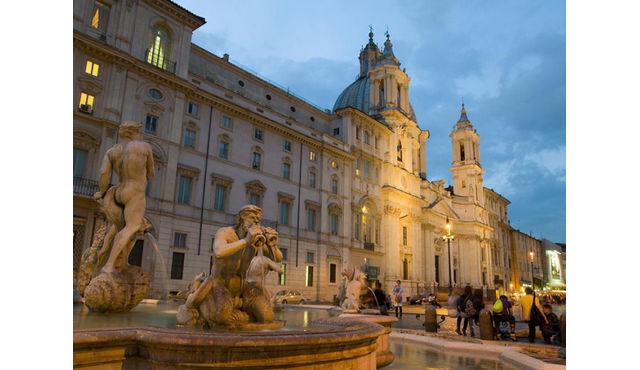
Fri 17:45
Great Symphonies at Piazza Navona
Sant’Agnese in Agone
In this highly-anticipated concert, hear the mellifluous sounds of chamber music by Mozart and Beethoven at Rome's treasured and world-renowned Sant’Agnese in Agone.
Booked via Classictic
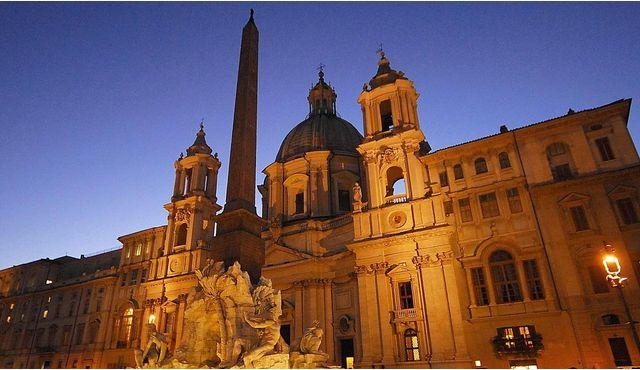
Sat 17:00
Viva Vivaldi: The Four Seasons in Piazza Navona
Sant’Agnese in Agone
Experience Vivaldi's masterpiece in an arrangement for piano quintet in Rome.
Booked via Classictic
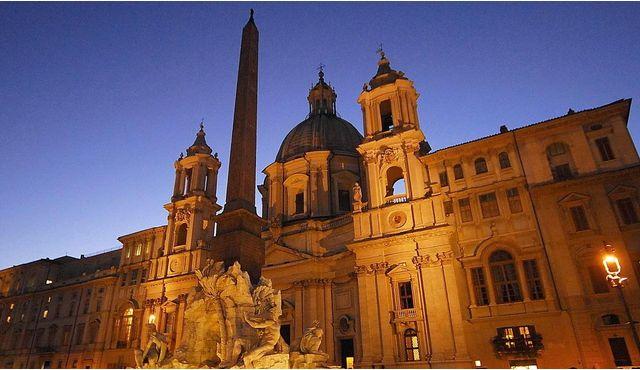
Tue 17:45
Love Cello Duet, The best of Chopin and Beethoven at piazza Navona
Sant’Agnese in Agone
Inside the wonderful baroc jewel, the famous Borromini Sacristy of the Sant'Agnese in Agone Church in piazza Navona, the heart of Italian history and …
Booked via Classictic
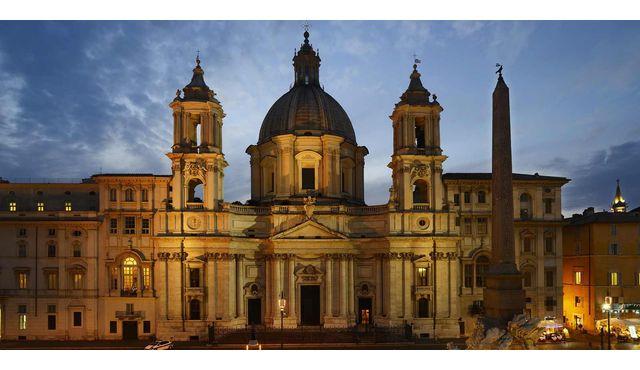
Wed 17:45
Great Opera: Piazza Navona in Rome
Sant’Agnese in Agone
Experience some of the most beautiful 19th century opera arias.
Booked via Classictic
Thu 17:45
Liszt and Friends: Concerts at Sant’Agnese in Agone (Sala Borromini)
Sant’Agnese in Agone
Experience the harmonious blend of classical music and historic ambiance at 'Liszt and Friends: Concerts in Rome.' Set against the stunning backdrop of Sant’Agnese …
Booked via Classictic

Fri 17:45
Great Symphonies at Piazza Navona
Sant’Agnese in Agone
In this highly-anticipated concert, hear the mellifluous sounds of chamber music by Mozart and Beethoven at Rome's treasured and world-renowned Sant’Agnese in Agone.
Booked via Classictic
No dates for this selection. Reset a filter.
Dates come directly from our ticket partners Classictic and Music-Opera and are updated every night. Prices and availability are shown by the partner, where you book with instant e-mail confirmation. If you book through these links we earn a small commission at no extra cost to you. Showing the next 6 of 22 dates.
Is Sant’Agnese in Agone worth visiting – and the crypt?
Because the church stands on one of Rome’s busiest squares, it is often overlooked. The interior is worth a short stop, the crypt a planned visit: there you can see how antiquity and the Baroque are layered on top of each other.
Yes, if…
- you are on Piazza Navona and want a break from the crowds – the church is on the west side of the square.
- you want to see Borromini, Rainaldi and Bernini in one building.
- you are interested in the ancient city beneath the Baroque: the crypt shows walls of the Stadium of Domitian and building phases up to the Baroque period.
- you enjoy concerts: the church hosts the “I Concerti in Chiesa” series and a season in the Borromini sacristy.
Perhaps not, if…
- you are coming on a Monday: it is closed then.
- you want to see the crypt on the spur of the moment: it can only be visited by compulsory booking.
- you have reduced mobility: the church and crypt are not accessible; ask in advance in any case.
Our tip: Come between Tuesday and Saturday and book a crypt slot in advance within the crypt’s hours; the church stays open longer than the crypt slots. Check the church’s website before your visit, as restoration work may affect access (as of 14 November 2026).
Editorial assessment by Treffpunkt Rom based on the facts above – not a substitute for checking the official information.
Church and crypt: times and prices
| Area | Times | Admission |
|---|---|---|
| Church Tue–Fri | 9 am – 1 pm, 3–7 pm | No ticket |
| Church Sat/Sun | 9 am – 1 pm, 3–8 pm | No ticket |
| Church Monday | Closed | – |
| Crypt Tue–Sat | 9 am – 1 pm (last entry 12:30 pm), 3–6 pm (last entry 5:30 pm) | €5 adults, booking compulsory |
As the church and crypt have different hours, your booked slot is what counts for the crypt.
Crypt rules: Adults pay €5. Admission is free for children aged 0–5, people with disabilities (and a companion where applicable) and licensed tour guides. The visit lasts about 20 minutes; an information leaflet is available in Italian, English, Spanish, French, German and Portuguese.
Planning your visit: Mass, concerts, access
- Mass times: Saturday 7 pm; Sundays and public holidays 12:15 pm and 7 pm.
- Concerts: The “I Concerti in Chiesa” series and a separate season in the Borromini sacristy are announced; check the website for dates and prices.
- Accessibility: The church and crypt are not accessible for visitors with reduced mobility. For general information, see the “Roma accessibile” page.
- Building work: The heritage authority has reported damage to the roof and windows and damp in the crypt. Access may change.
- Dress code: As it is a church, modest dress is sensible.
- Duration: Church 15–30 minutes, crypt about 20 minutes.
The building: three architects, one façade
The patron was Pope Innocent X of the Pamphilj family; the church was conceived almost as a family chapel next to Palazzo Pamphilj. Girolamo and Carlo Rainaldi presented the first design in 1652. Francesco Borromini took over in 1653 and in 1657 either resigned or was dismissed. Carlo Rainaldi completed the towers and lanterns by 1672. Bernini altered the façade in 1667.
The concave façade is flanked by two bell towers requested by Camillo Pamphilj. Borromini replaced the originally planned dome with one set further back. The dome shell was built in the summer of 1654 and painted in 1670–1689 (Ciro Ferri, Baciccia). The interior is clad in marble, including red-flecked brocatello, and decorated with reliefs by Domenico Guidi, Raggi and Ferrata.
The skull of Saint Agnes is venerated in a side chapel. Innocent X was reburied in 1677 in the Chapel of Santa Francesca Romana.
The crypt: antiquity beneath the Baroque
The old church was originally meant to become the crypt. In the basement are substructures of the Stadium of Domitian and building phases from antiquity to the Baroque – so a visit to the crypt shows you the history of the site from below.
History: from place of martyrdom to Pamphilj church
According to tradition, Saint Agnes was stripped in the stadium; the church commemorates the martyr. A Christian place of worship is documented from the 8th century; the present building was commissioned by the Pamphilj from 1652. The earlier church was consecrated on 27 or 28 January 1123.
- 8th century First mention of a Christian place of worship.
- 920 Benedictines from Farfa are present.
- 1123 Consecration of the earlier church (27 or 28 January).
- 1517 Becomes a titular church under Leo X.
- 15 August 1652 Foundation stone of the present church.
- 1653 Borromini takes over; Innocent X donates twelve columns from the Lateran.
- 1654 The dome shell is built.
- 1657 Borromini leaves the project.
- 1667 Bernini alters the façade.
- 17 January 1672 Consecration of the church.
- 1670–1689 Dome frescoes.
- 1677 Innocent X is reburied in the church.
Curiosities & surprises
- Saint Agnes’s hairLegend / disputedAccording to tradition, Agnes was stripped in the stadium – and her hair miraculously grew to cover her.
- The Nile and the façadeLegend / disputedThe Nile on the Fountain of the Four Rivers supposedly covers his head so as not to see Borromini’s façade – a tourist anecdote. It is chronologically impossible: the fountain was finished in 1651, and Borromini only took over in 1653.
- Stadium seats in the façade?Legend / disputedSeating steps from the stadium are said to have been reused.
- Police on the building siteWorkers who did not want to work on Sundays and holidays were brought to the site by the papal police to speed up construction.
- Twelve Lateran columnsIn 1653 Innocent X donated twelve columns from the Lateran Basilica.
- A dispute over the stepsCamillo Pamphilj extended the steps against the Pope’s wishes – which led to arguments.
- A window to the palaceThrough an opening in the drum, the family could follow Mass from the palace.
- A saint’s baptismSanta Francesca Romana was baptised in the church in 1384.
Getting there & location
Sant’Agnese in Agone stands on the west side of Piazza Navona (Via di Santa Maria dell’Anima 30/A, approx. 41.8992° N, 12.4728° E). Check public transport lines in a route-planning app. Many sights in the historic centre are within walking distance of Piazza Navona; Sant’Ivo alla Sapienza and the Pantheon are close by.
Nearby
- Piazza NavonaThe square in front of the church
- Sant’Ivo alla SapienzaBorromini’s spiral lantern, Mon–Fri mornings
- Palazzo AltempsAncient sculpture nearby
- PantheonClose by
- All sightsThe overview
Frequently asked questions
Is Sant’Agnese in Agone free to visit?
You can enter the church without a ticket. The crypt, by compulsory booking, costs €5 for adults (as of 14 November 2026).
When is the church open?
Closed on Mondays; Tue–Fri 9 am – 1 pm and 3–7 pm, Sat/Sun 9 am – 1 pm and 3–8 pm.
Can you visit the crypt?
Yes, Tuesday to Saturday by compulsory booking; the visit takes about 20 minutes.
Who built the church?
Girolamo and Carlo Rainaldi designed it in 1652; Borromini worked on it in 1653–1657, and Carlo Rainaldi completed it by 1672.
Is the story about the Nile and Borromini true?
No, it is chronologically impossible: the fountain was finished in 1651, and Borromini only arrived in 1653.
What lies beneath the church?
Substructures of the Stadium of Domitian and building phases from antiquity to the Baroque.
Are there concerts?
Yes – the “I Concerti in Chiesa” series and a season in the Borromini sacristy; check the website for dates.
Is the church accessible?
The church and crypt are not accessible for visitors with reduced mobility; please ask the church in advance.
Could access change?
Yes – a restoration programme by the heritage authority mentions roof damage and damp; check the church’s website first.
Sources & last checked
All time-sensitive information (opening times, prices, rules) was checked on 14 November 2026. The official websites always take precedence – subject to change.
- Church website – Sant’Agnese in Agone
- Opera Romana Pellegrinaggi – church and crypt
- Turismo Roma – Sant’Agnese in Agone
- Wikipedia (German) – Sant’Agnese in Agone
- Wikipedia (English) – Sant’Agnese in Agone
- Wikipedia (English) – Fountain of the Four Rivers
- Tourist in Rom – church opening hours (secondary source)